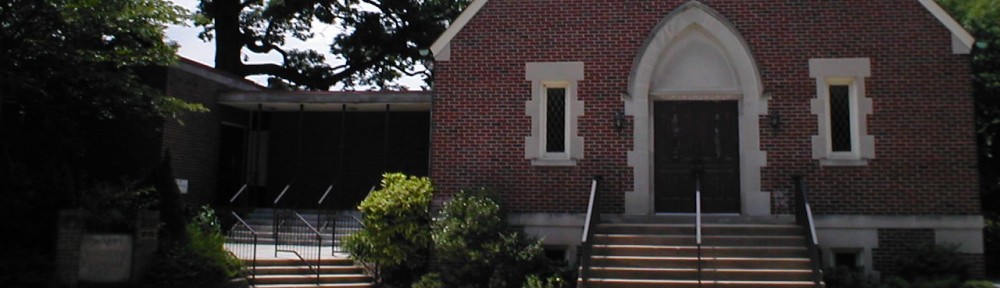
This is another in a series of occasional articles about our Congregation’s history in honor of our 95th Anniversary year.
To begin this article, a little explanation is in order about the title. Using Biblical language and images, the Church is often referred to in feminine language. We also see this in languages where nouns are classified by gender that the word used for “church” is identified as feminine; for example, in German it is “die Kirche” (as in a church building) or “die Gemeinde” (as in a church congregation), where “die” (pronounced like the letter “D”) is the feminine article. This idea of the Church being feminine arises from the Church being called in Scripture “the Bride of Christ”, who has been purchased and won from her sins by her Bridegroom, Jesus Christ (see Ephesians 5:25-27 and elsewhere).
Using this same idea, when we speak of the relationship between congregations of the same Christian confession and denomination, we often refer to them as “sisters”. Also, when one congregation begins a new worshiping community, the founding congregation is called a “mother”, and the newly planted congregation is known as a “daughter”. And it is such a relationship which began our Trinity Congregation.
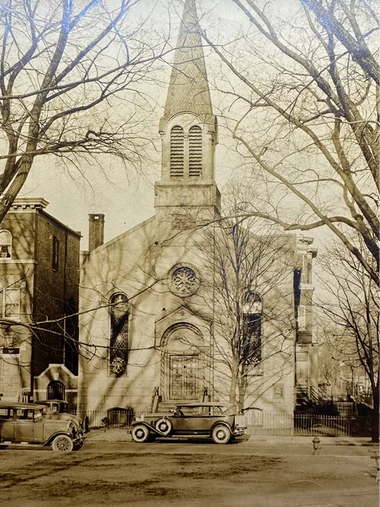
On November 2, 1851, the Trinity German Evangelical Lutheran Church of the Unaltered Augsburg Confession was founded. This congregation was begun by members from the German Evangelical Lutheran Church of Washington, which at that time was the only German speaking Protestant congregation in the city. The reason these members left their congregation was because of the mixing between the teachings of the Lutheran and the Reformed faith, especially regarding the Presence of Christ in the Lord’s Supper, which at this time was common even in Lutheran Churches in Germany. (This was also the reason which a group of Lutherans from Saxony left Germany to come to the United States in 1838-39, settled in Saint Louis, and founded what became the Lutheran Church-Missouri Synod in 1847.) This new congregation began worshiping at the Temperance Hall located at 9th and E Streets, NW until 1857, when a new church building was dedicated at 4th and E Streets, NW, where the congregation remains today, though in a new building built on the same site in 1959.
Trinity Lutheran Church of Washington worshiped in the German language from its beginning. And because of this, she became the mother to several other Lutheran congregations in the Washington area. In the latter part of the 1800’s, Trinity formed two congregations for those who desired to worship in the English language. It was only in 1898 that Trinity began to hold English language evening worship services, later transitioning to worshiping in all English.
There was a mission-mindedness within the congregation which led them to find ways to extend the sharing of the Gospel elsewhere in Washington, DC and its surrounding area. In 1927, a group of women at Trinity-Washington organized a mission society with the purpose of aiding in the establishment of mission churches. This group and the congregation resolved to sponsor a branch mission church and to assume its beginning expenses. They petitioned the Mission Board of the Evangelical Lutheran Synodical Conference of North America for a student assistant (Vicar) to help begin this new mission. And in 1931, the faculty at Concordia Seminary, Saint Louis, assigned Student Edwin E. Pieplow to come to Washington to work at this mission start.
Arriving in Washington, Vicar Pieplow began his work by preaching his first sermons in the area in both German and English during services at Trinity-Washington. He then worked alongside members of the congregation in canvassing the community which was chosen to plant this new mission: the “new” suburb of Mount Rainier, Maryland (which was founded in 1910). Following a rather favorable canvassing effort, Trinity-Washington’s mission society rented the town’s Odd Fellows Hall to be used as a worship site. And on October 11, 1931, the first worship services of the new Trinity Mission were held.
Until 1934, the mission continued as a part of the ministry of Trinity-Washington. In that year, Student Pieplow returned to Washington after the completion of his seminary studies, and he was ordained and installed as the Pastor of Trinity-Mount Rainier. At that time, Trinity-Washington then established the Mount Rainier Mission as a separate Congregation.
The relationship between “mother” and “daughter” continued in the early days of Trinity-Mount Rainier’s life, with the Pastor of the mother church often participating in major milestone events such as the cornerstone laying and dedication of Trinity-Mount Rainier’s church building, as well as anniversary celebrations.
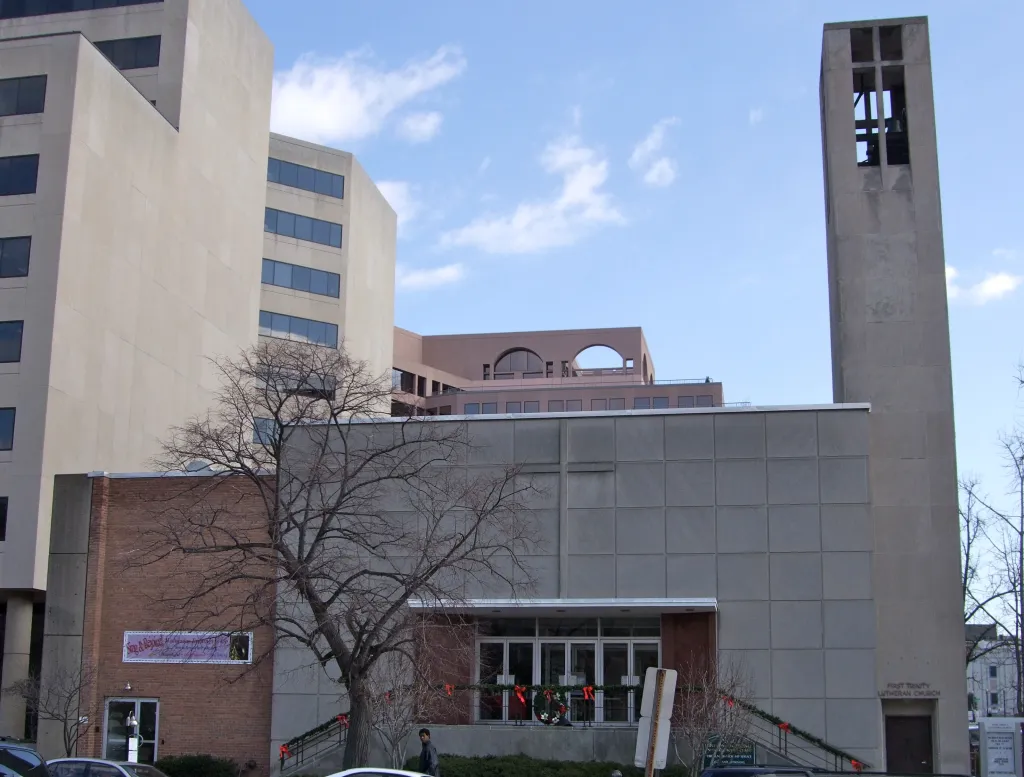
Thanks be to God, our mother church still remains an active congregation in downtown Washington. One note though, she is now known as First Trinity Lutheran Church. This new name arose because of the confusion that there was sometimes as there were two “Trinity Churches” in relatively close proximity to each other. In the booklet prepared for our Tenth Anniversary in 1941, along with some historical notes there was a section titled, “Did You Know That?”, which had the following: “There is more than one Trinity church, yet there should be no confusion or inconvenience experienced if our church is referred to as TRINITY, MT. RAINIER”. Trinity-Washington chose later to be called by the name of First Trinity, as she was the first congregation to have that name in Washington, DC.
More history can be read about our mother church from their website: https://www.firsttrinitydc.org/who-we-are, where you can also view a “family tree” of the congregations begun by First Trinity.
We will follow up on this article with the story of how our congregation in turn also became a mother church as well.